Connecting Business Intent to Code
Last updated 1 day ago
Code describes what a system executes. It does not necessarily preserve every reason the system was built that way: a business rule, a contractual exception, a product tradeoff, an operational constraint, or a problem reported by a customer.
Code is a lossy projection of business intent.
That distinction matters when developers and AI agents need to understand, fix, or evolve an application. Analyzing an implementation helps explain its behavior. Deciding how it should behave also requires access to the context that gives it meaning.
Mobioos connects these two dimensions. Mobioos Fusion structures and centralizes business context. Mobioos Forge maps that context to code and makes it available in development workflows.
Business intent becomes an entry point into the codebase, down to the code selections associated with it.
Why Code Alone Is Not Enough
A condition in the code may implement an eligibility rule. It does not necessarily explain who defined that rule, why it includes an exception, or when it should change.
Likewise, a function may recalculate an amount without explaining the commercial policy behind that calculation. Its name, types, and dependencies describe the implementation. The decisions that justify it may be scattered across specifications, tickets, customer feedback, and other sources in the software factory.
Understanding software requires answering two complementary questions:
What does the system do? Code, tests, and technical analysis help answer this question.
What should it do, for whom, and why? Business rules, intent, and context provide the frame of reference.
An AI agent can produce a technically accurate explanation while missing a critical business exception. It can also propose a change that makes sense locally but conflicts with a requirement absent from the context it received.
The quality of a code change also depends on the quality of the connections between implementation and business context.
Mobioos structures those connections so that meaning does not depend solely on file names, technical identifiers, or knowledge held by the people who originally built the system.
Start with Business Intent. Find the Implementation.
Mobioos organizes context through an explicit chain:
Ontology → Domain Context → Context Object → Code Parcel → Codebase
This chain connects a business model to concrete locations in the code. It represents semantic relationships and mappings, rather than an automatic code generation pipeline.
The Ontology Defines the Semantic Structure
An ontology describes the concepts and relationships that structure a domain. It provides the framework for interpreting project data and code.
For example, orders, returns, refunds, and discounts can have specific business relationships. This framework helps distinguish closely related concepts and connect information expressed in different vocabularies.
In Mobioos, ontologies are managed by Mobioos Fusion.
The Domain Context Instantiates an Ontology
A Domain Context is an instance of an ontology. It contains the context objects associated with relevant project information and code.
A Domain Context gives the semantic model a concrete application. It is distinct from both the ontology that structures it and the repository folders that organize the implementation.
The Context Object Connects Business Meaning to Code
A Context Object belongs to a Domain Context. It is the connection point between relevant business information and the associated Code Parcels.
A context object brings information together around a shared meaning, even when that information uses different terminology or lives in different technical locations.
The Code Parcel Connects That Meaning to a Collection of Code
A Code Parcel is a collection of code selections treated as a single unit. It can include individual words, lines, code blocks, entire files, and folders.
A Code Parcel can span multiple repositories and branches within the same project. Each Code Parcel is associated with a Mobioos context object.
This granularity captures a business concern that may not match the software's folder structure. One feature might involve a few lines in one service, a validation in another, and a processing step in a third repository.
A Code Parcel brings those selections together without requiring the file architecture to mirror the business model.
The Codebase Keeps Its Technical Structure
Code selections remain in the codebase. Mobioos adds a business interpretation that complements the existing technical structure.
Code mapping runs locally through the Mobioos Forge VSIX extension. Source code is never sent to the Mobioos Fusion SaaS. Mobioos calls this architecture IP Proof: business context is centralized in Fusion, while code mapping takes place in the developer's local environment.
Developers can approach the code through business intent, then inspect the functions, dependencies, and tests needed for the task.
Polarize Data from the Software Factory
Useful software context extends beyond source code. It also comes from the tools and information involved in designing, operating, and evolving the application.
Mobioos Fusion captures data from this ecosystem through connectors and polarizes it: filtering out noise and intelligently projecting relevant information onto the semantic structure defined by the ontologies.
Data polarization connects information to business meaning. It makes that information usable in relation to context objects and, through them, the associated code.
Endogenous Data Describes the Implementation
In this framework, endogenous data relates directly to the implementation: a diagnostic tied to a code location, a defect identified in a function, or information about technical behavior.
It helps explain what is happening in the software and where a technical investigation should focus.
Exogenous Data Describes Usage and Intent
Exogenous data expresses a need or event outside the implementation: a customer ticket, a functional rule, or feedback about the application's behavior.
Users generally describe what they observe and what they expect. They do not know which functions, repositories, or branches are involved.
This distinction depends on the information itself, not just its source. A single ticket can contain both a business symptom and a technical diagnosis.
Mobioos connects this information to context objects and then to the associated code selections. Customer language and implementation language can meet within a shared semantic structure.
Map Code Through AI Inference and Developer Input
A business model becomes operationally useful when its connections to code are relevant. Mobioos combines two ways to define Code Parcels.
Ontology-Guided Inference
In Mobioos, inference is the process by which Mobioos AI selects code to form Code Parcels.
During scanning in Forge, the ontology underlying the relevant Domain Context guides the identification of code selections and their associations with context objects. A business framework is therefore in place before scanning begins.
Developer-Created Markers
Developers can manually select code and associate it with context objects. These manual markings are called Markers.
A Code Parcel is the collection of code. A Marker is a manual marking used to define that collection.
Two Approaches That Work Together
A single Code Parcel can combine selections identified through inference with selections marked manually using Markers.
Developers can also correct inaccurate inferences or refine partially correct results. Their expertise complements the AI's work to improve the relevance of code selections and their business associations.
Mapping accuracy depends on the ontology, the available context, and the quality of the associations established. Inference accelerates discovery; developer input allows those associations to be refined.
From a Customer Ticket to Lines of Code
Consider a commerce application. A customer reports:
“After I return one item, the discount disappears from my entire order.”
The message describes a user experience. The implementation may use names such as recompute, adjustment, or eligibility, and the relevant behavior may span multiple services.
The following example illustrates how Mobioos structures the investigation. It is a workflow example, not a performance benchmark.
1. Structure the Business Concepts
The ontology defines the relevant concepts, such as orders, returns, and discounts, and their relationships. The Domain Context contains the context objects for the project's business scope.
2. Connect the Customer Information
Relevant information from the ticket is captured and polarized toward the appropriate context objects. The reported symptom joins a business structure that is also connected to code.
3. Find the Implementation Scope
The context objects are associated with Code Parcels. Those parcels identify relevant code selections, even when they are distributed across the project's repositories and branches.
4. Investigate with Business Context
The developer or AI agent starts with the reported symptom, its business meaning, and a relevant set of code selections to inspect.
The semantic connection helps locate relevant code. It does not, by itself, prove the root cause of the defect. Behavioral analysis, testing, and functional validation remain necessary.
The starting question becomes more precise: “Which code selections are associated with the business objects involved in this issue?”
How Mobioos Extends Existing Context Practices
Teams already use documents, rules, search, and navigation tools to understand their projects. Mobioos complements these practices by structuring the relationships between intent, data, and code.
Markdown: A Format for Knowledge and Context Delivery
Markdown files are useful for documenting projects and guiding AI agents. They can contain specifications, business rules, and explicit references. Some tools apply instructions to an entire repository or to defined paths, without necessarily relying on embeddings to select them. GitHub documentation on repository instructions.
However, the Markdown format does not itself define the relationship between a business object, the data that enriches it, and the associated code selections.
In Mobioos, the context model and mapping establish that relationship. Markdown files can then use it: Mobioos context variables populate files with object context that Forge keeps up to date.
Context Bloat: When Documentation Overloads the Context Window
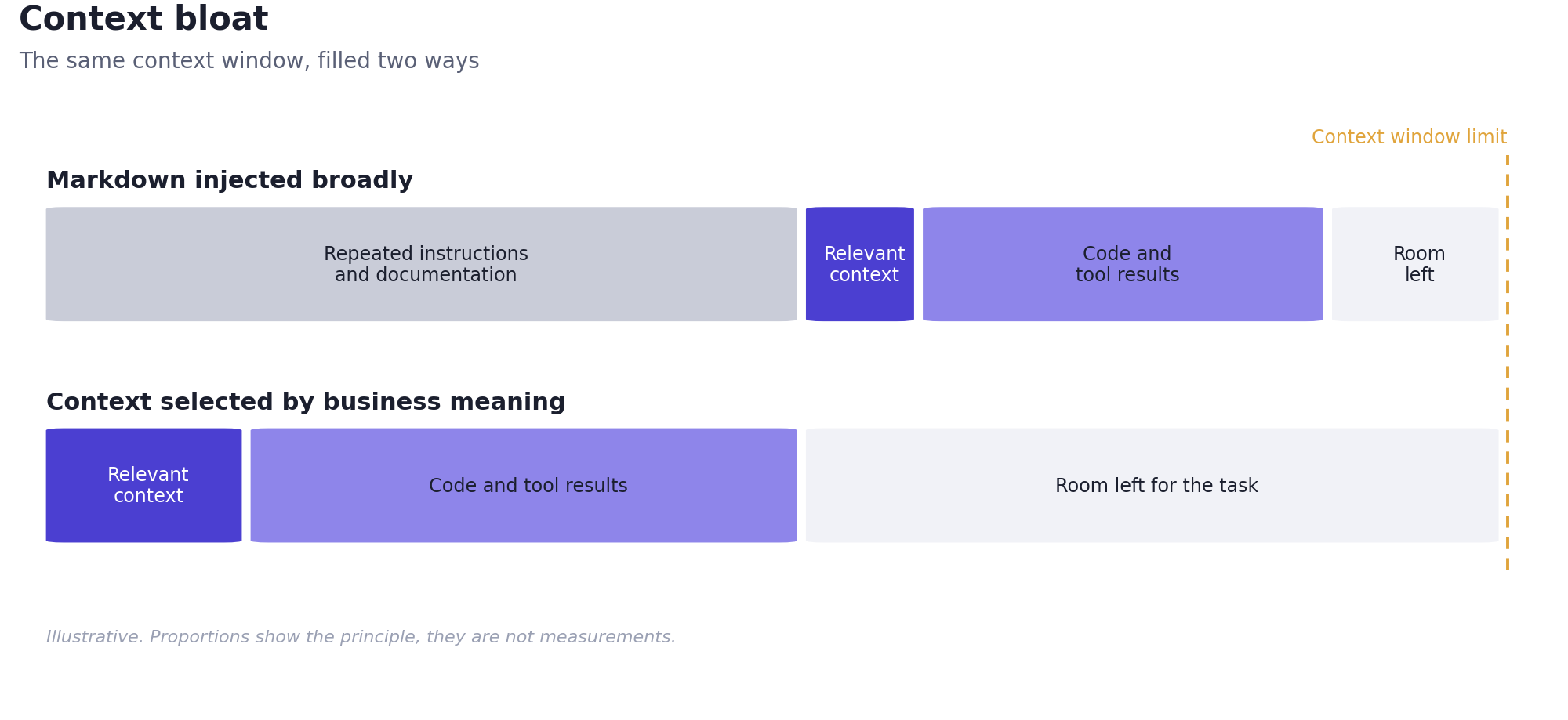
Large, repetitive, or poorly scoped Markdown files can add documentation bloat to a repository. When that content is injected too broadly into requests, it creates context bloat: more information in the model's context window than the task requires.
Depending on its configuration, an agent may load substantial instructions at the start of a session. This is not universal: agents do not all automatically load every Markdown file. The risk comes from the volume, relevance, and repetition of the content actually supplied to the model.
Excess content can increase processed tokens, cost, and latency while leaving less room for relevant code, tool results, and subsequent interaction. Repository documentation bloat can become model context bloat.
Context Rot: When More Context Becomes Less Useful
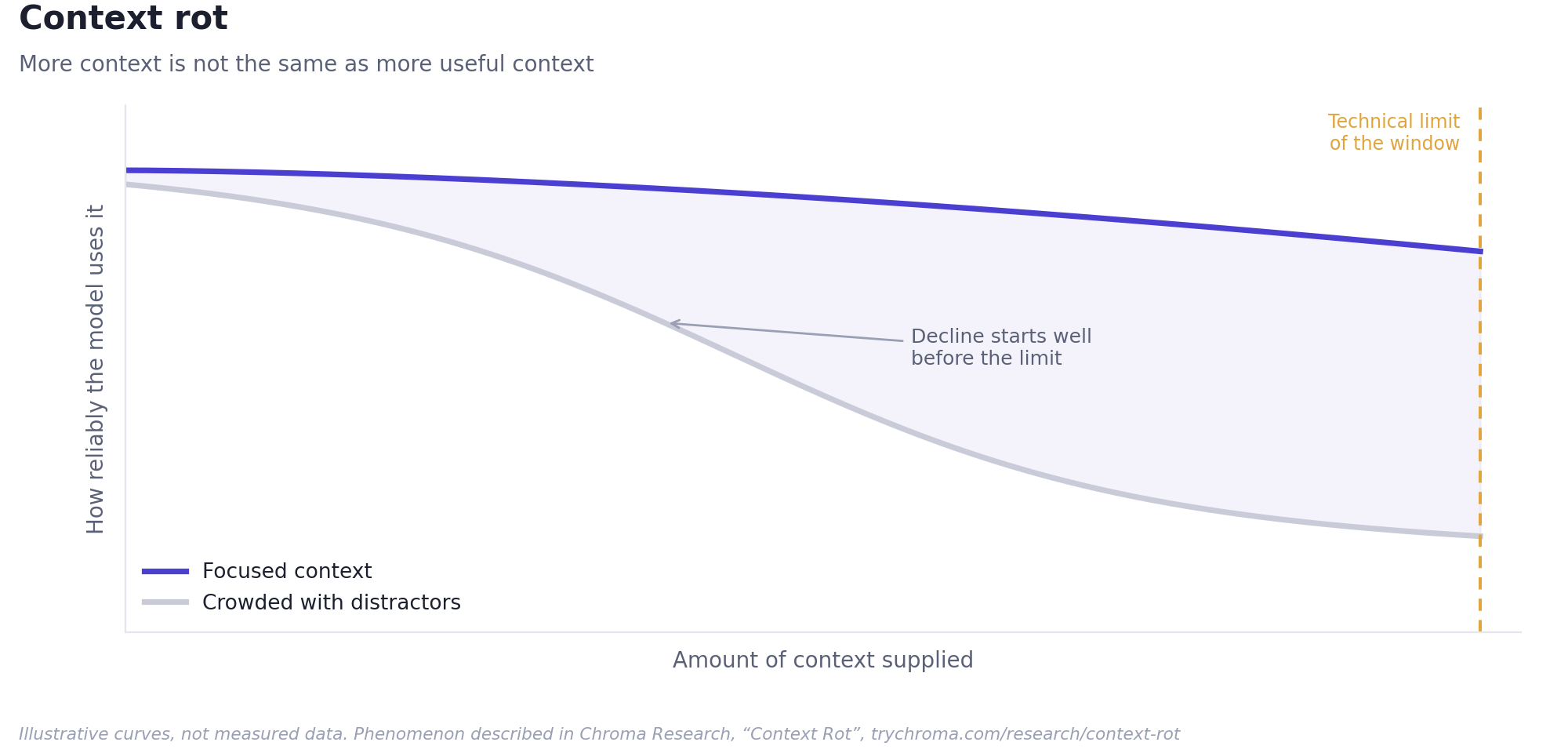
Context rot describes a decline in a model's ability to use information reliably as context grows or becomes crowded with distractors. It can occur before the context window reaches its technical limit, and it does not necessarily produce a sudden or uniform collapse in performance. Chroma's research on context rot.
A model accepting a large input does not mean it will use every part of that input equally well. Context engineering therefore focuses on selecting useful information and managing its volume. Context engineering for AI agents.
For enterprises, less reliable responses can lead to rework, additional checks, and repeated model calls. Combined with oversized inputs, these effects can make recurring agent use more expensive and harder to scale.
The Mobioos Approach: Context Selected by Business Meaning
Data polarization filters noise from software factory data. Context objects and Code Parcels establish the business associations used to retrieve relevant context. Mobioos variables can then populate Markdown files with that context, reducing the need to maintain repeated static copies of business information.
This approach is designed to prevent indiscriminate context accumulation and reduce exposure to context bloat and context rot. Its effectiveness depends on the scope retrieved and the amount ultimately supplied to the model. A dynamically populated Markdown file can still overload a request if it contains too much information. Accuracy and token savings should be measured on real tasks.
Semantic Search: Finding Related Content
Embeddings can connect content by meaning even when the words differ. They are a useful mechanism for search and context retrieval. Embeddings documentation.
Semantic similarity is a relevance signal. By itself, it does not prove that a code selection implements a particular business rule.
Mobioos adds a mapping between context objects and Code Parcels. That mapping can be inferred, extended manually, and corrected by the developer.
Specs, Domain Models, and Graphs: Complementary Approaches
Starting with the business domain is an established practice, notably in Domain-Driven Design. Tools such as Kiro also offer requirements-first workflows. Knowledge graphs and GraphRAG represent entities and relationships to enrich context retrieval. Domain-Driven Design, Kiro Specs, GraphRAG.
Mobioos brings these needs together operationally: an ontology-based framework, Domain Contexts, polarized data, and mappings to Code Parcels that developers can refine and use in their workflow.
A Shared Connection for Product and Engineering
The same semantic chain provides different entry points for different responsibilities.
This model helps teams discuss the same subject without requiring everyone to adopt the same technical vocabulary. Product can start from a business concept, engineering can find the associated code, and architecture can examine how that code is distributed.
The goal is to reduce the effort required to establish this connection before teams can discuss, decide, and act.
Put Context to Work with Fusion and Forge
Prepare Business Context in Mobioos Fusion
Before scanning, the team selects ontologies, creates their Domain Contexts, and populates them with context objects. It configures connectors for the relevant software factory data.
The quality of this preparation matters. A missing or ambiguous rule does not become reliable simply because an AI model analyzes more code.
Scan and Map with the Forge VSIX Extension
In a supported IDE, the Forge VSIX extension analyzes code and lets developers map it to context objects. Inference and Markers contribute to the definition of Code Parcels.
Code mapping takes place locally under Mobioos's IP Proof architecture. Source code is never sent to the Mobioos Fusion SaaS.
Developers can then use integrated features such as mapped code highlighting, business intent navigation, context retrieval, and dynamic Markdown context.
Use Context in Your Existing Workflow
The Forge npm package complements the VSIX extension with interoperability through Skills, Rules, MCP, and CLI. After mapping, developers can use these capabilities from their preferred environment, including another editor.
The VSIX extension handles scanning and mapping. The npm package makes context available through these interfaces. The two installations are complementary.
Measure Value Where It Matters
Context earns its value through use. Teams evaluating Mobioos can start with representative project tasks: understanding a feature, locating code related to a customer ticket, or preparing a business rule change.
A useful evaluation compares the same tasks, project versions, and accessible sources. It includes the initial cost of structuring context and the work required to maintain it.
Fine-grained mapping and developer correction are Mobioos capabilities. Improvements in time, accuracy, and cost should be observed in each team's real working environment.
Make Business Meaning Actionable
Repositories organize code. Ontologies structure business concepts. Domain Contexts and their objects give project context a concrete form. Code Parcels connect that structure to the implementation.
Mobioos lets teams start with what the software needs to accomplish and find the code that contributes to it.
A customer ticket can connect to a business object and then to the associated code selections. A business rule can become an entry point across repositories. An AI agent can receive relevant business context for the code it is examining.
Code remains a lossy projection of business intent. Mobioos builds the connections that help developers, product teams, and their AI agents recover the context they need to understand and evolve it.